I’ve seen leverage destroy more portfolios than almost any other financial tool.
You’re probably here because you want to know if leverage can actually help you build wealth faster. Or maybe you’ve heard the horror stories and want to understand what went wrong.
Here’s the truth: leverage works. But it cuts both ways.
I spent years studying how people use borrowed money to grow their wealth. Some made fortunes. Others lost everything. The difference wasn’t luck.
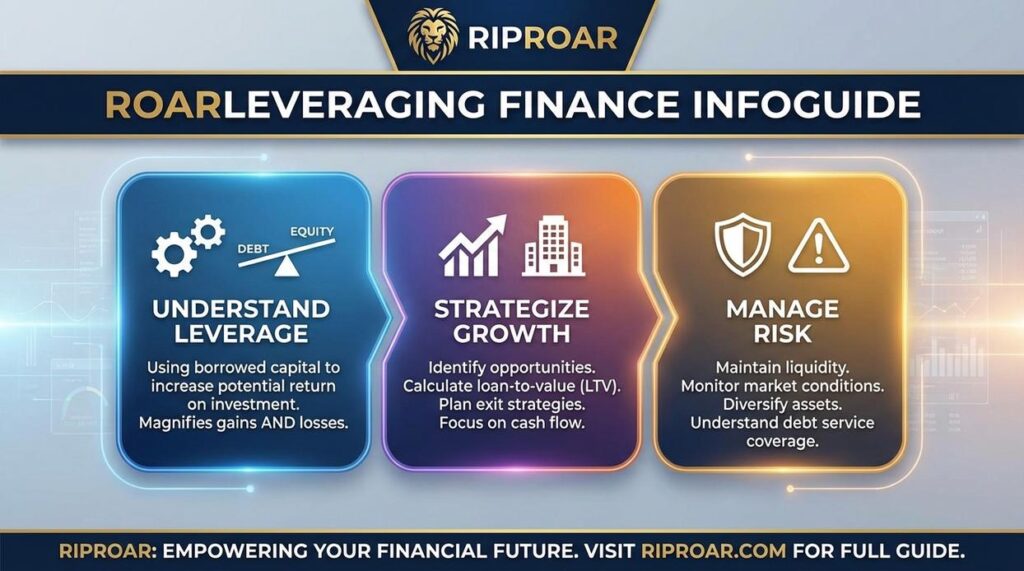
This roarleveraging finance infoguide from riproar breaks down exactly what financial leverage is and how it actually works. I’ll show you the mechanics behind it and why it can multiply your gains or wipe you out.
We focus on the risk side first at Roar Leveraging. Not because we’re pessimistic. Because that’s what keeps you in the game.
You’ll learn the basic concepts, see real examples of leverage in action, and understand the debt structuring techniques that separate smart borrowers from reckless ones.
No hype about getting rich quick. Just a clear framework for using leverage without blowing up your financial life.
What is Financial Leverage? The Core Concept Explained
You know what drives me crazy?
People throw around the word “leverage” like everyone just knows what it means. They don’t explain it. They assume you get it.
Then you’re sitting there feeling dumb because you’re not sure if you should be excited or terrified when someone says a company is “highly leveraged.”
Let me clear this up.
Financial leverage is just using borrowed money to invest. That’s it. You take on debt to buy something that (hopefully) makes you more money than the debt costs you.
Think about a basic lever from physics class. You push down on one end and the other end lifts something way heavier than you could lift with your hands alone. The lever amplifies your force.
Debt does the same thing with your investment power.
Say you have $10,000. You could buy a $10,000 investment. Or you could borrow another $10,000 and buy a $20,000 investment. If that investment goes up 10%, you just made $2,000 instead of $1,000.
(Of course, if it drops 10%, you’re in a worse spot. But we’ll get to that.)
The debt-to-equity ratio tells you how much someone is using this strategy. It’s just total debt divided by total equity. A ratio of 2:1 means for every dollar you own, you’ve borrowed two more.
Here’s where people mess up.
Not all leverage is the same. Using debt to buy a business or real estate that goes up in value? That can work. The roarleveraging finance infoguide from riproar breaks this down better than most resources I’ve seen.
But borrowing money for a car that loses value the second you drive it off the lot? That’s just expensive stupidity with extra steps.
The Mechanics: How Leverage Amplifies Gains and Losses
Here’s what most people don’t get about leverage.
It’s not just about borrowing money to buy more stuff. It’s about how the math works when you control assets you don’t fully own.
And honestly? The math is both beautiful and terrifying.
Let me show you what I mean.
The Core Principle
When you use leverage, your returns get calculated on the total investment size. Not just the cash you put in.
That’s the whole game right there.
Say you invest $10,000 of your own money and borrow $90,000. You now control a $100,000 asset. If that asset goes up 10% to $110,000, you’ve made $10,000 on your original $10,000. That’s a 100% return (minus what you pay in interest). In the world of gaming investments, understanding the concept of Roarleveraging can transform your approach to asset control, allowing you to maximize returns on your initial capital by strategically borrowing against your investments. In the world of gaming investments, understanding the concept of Roarleveraging can transform your approach to asset management, enabling you to amplify your potential returns by strategically using borrowed capital.
Your friend who invested $10,000 without borrowing? They made $1,000. A 10% return.
Same asset. Same time period. Wildly different outcomes.
When Things Go Right
The upside scenario looks pretty good on paper. You put in $10,000. The asset climbs to $110,000. After paying back the $90,000 loan, you’re left with $20,000 in equity.
You just doubled your money while the asset itself only moved 10%.
This is why people get excited about leverage. It turns modest gains into serious returns.
When Things Go Wrong
But here’s where my opinion differs from the cheerleaders.
Most content about leverage focuses on the wins. I think that’s backwards. You need to understand the losses first.
Same setup. You invest $10,000 and borrow $90,000 to buy that $100,000 asset.
Now it drops 10% to $90,000.
You still owe $90,000. Your equity? Gone. Completely wiped out. That’s a 100% loss on your capital.
And if it drops more than 10%? You’re not just broke. You owe money.
The Cost You Can’t Ignore
Here’s what kills most leveraged plays.
Interest.
You’re paying to borrow that $90,000. Maybe it’s 5% a year. Maybe it’s 8%. Whatever it is, that’s your hurdle.
Your investment needs to beat that rate just to break even. If you’re paying 6% on borrowed money and your asset only returns 4%, you’re losing money even though the asset went up.
I’ve seen people forget this part. They focus on asset appreciation and completely miss that the debt is eating their returns alive.
What This Means for You
Leverage isn’t good or bad. It’s a tool that makes everything bigger.
Bigger wins. Bigger losses. Bigger stress.
The business tips and tricks roarleveraging approach comes down to knowing your numbers cold before you borrow a dime.
- Know exactly what you’re paying in interest
- Know what return you need to break even
- Know what happens if things drop 10%, 20%, or 30%
If you can’t answer those questions, you’re not ready to use leverage.
And honestly? That’s okay. There’s no shame in using your own capital until you understand the mechanics inside and out.
Common Types of Leverage in Investing and Business

You’ve probably used leverage without even realizing it.
That mortgage on your house? That’s leverage. And honestly, it’s one of the smartest financial moves most people ever make.
Here’s what I mean.
Real estate mortgages let you put down 20% and control an asset worth five times that amount. The property appreciates (hopefully) while you’re only paying interest on borrowed money. I’ve seen people turn $50,000 into $250,000 in equity over a decade. Not because they’re geniuses. Because they understood this basic principle.
But mortgages are just the beginning.
Margin trading is where things get interesting. And by interesting, I mean risky. You borrow money from your broker to buy more stocks than you could afford with cash alone. When it works, your gains multiply. When it doesn’t? You get a margin call, and your broker starts selling your positions whether you like it or not. I explore the practical side of this in Roarleveraging Business Infoguide by Riproar.
I’m not against margin trading. But I think most people underestimate how fast things can go sideways (the roarleveraging finance infoguide from riproar covers this better than most resources I’ve seen).
Business loans work differently. Companies borrow to buy equipment or fund expansion. The goal is simple: make more money from that investment than you’re paying in interest. A restaurant borrows $100,000 to open a second location. If that location generates enough profit to cover the loan payments plus extra, that’s good debt. In the competitive landscape of business loans, understanding the nuances of financing can be crucial, which is why many entrepreneurs are eager to learn how to get free financial advice Roarleveraging to maximize their investments and ensure profitable growth.How to Get Free Financial Advice Roarleveraging When navigating the complexities of business loans, savvy entrepreneurs often wonder how to get free financial advice Roarleveraging in order to maximize their investments and ensure that their new ventures, like a second restaurant location, thrive without being overwhelmed by interest payments.How to Get Free Financial Advice Roarleveraging
Then there’s the big leagues.
Leveraged buyouts happen when investors acquire entire companies using mostly borrowed money. They use the target company’s own assets as collateral. It’s bold. It’s complicated. And when it works, the returns are massive.
But that’s a whole different game.
Strategic Debt Structuring for Wealth Portfolio Planning
I learned this the hard way back in 2017.
I watched a friend take on massive debt to buy rental properties. He didn’t check his risk tolerance first. When rates jumped 18 months later, he couldn’t cover the payments.
That’s when I realized something. Debt isn’t the enemy. Bad debt structuring is.
Now some people will tell you to avoid leverage completely. They say it’s too dangerous and you should only invest what you have. I understand where they’re coming from. They’ve seen people get burned.
But here’s what that advice misses.
Strategic debt can actually protect your wealth when you structure it right. The key is knowing how to match your borrowing to your actual capacity.
1. Assess Your Risk Tolerance First
Before you borrow a single dollar, you need to know what you can lose.
I’m not talking about what you think you can handle. I mean what you can actually absorb if things go sideways.
Ask yourself this. If your investment drops 30% tomorrow and you still owe the debt, can you sleep at night? Can you keep making payments?
If the answer is no, you’re not ready for that level of leverage.
2. Analyze Your Cost of Debt
Interest rates matter more than most people think.
When I started using leverage three years ago, I spent two months just comparing loan terms. The difference between a 5% rate and a 7% rate on a $200,000 loan? That’s $4,000 a year.
Look at the full picture. What are the covenants? When can the lender call the loan? What happens if you need to refinance?
Lower cost of capital gives you breathing room. That margin of safety is what keeps you in the game when markets get choppy.
3. Match Your Assets and Liabilities
This is where most people mess up.
You don’t fund a 30-year property investment with a 3-year loan. The math just doesn’t work when that short-term debt comes due.
I use this rule. Long-term assets get long-term debt. Short-term needs get short-term financing.
Real estate? I’m looking at 15 to 30-year mortgages. Working capital for a business opportunity? Maybe a 2-year line of credit.
The timeline has to match. Otherwise you’re setting yourself up for a liquidity crisis.
4. Apply Leverage to Specific Parts of Your Portfolio
Here’s the thing about leverage. It’s not an all-or-nothing decision.
I keep most of my portfolio unleveraged. But I use debt strategically on the parts where I have high conviction and the numbers make sense.
Maybe that’s a rental property in a growing market. Or a business expansion where I can see clear cash flow projections.
The rest? I leave it alone.
This approach from the roarleveraging finance infoguide from riproar has kept me out of trouble more times than I can count. You get the upside of leverage without betting your entire financial future on it. Embracing the concept of Roarleveraging has not only enhanced my gaming experience but has also provided a strategic safety net, allowing me to enjoy the thrill of risk without jeopardizing my financial stability. Embracing the concept of Roarleveraging has not only enhanced my gaming experience but has also provided a safety net that allows me to explore new strategies without the fear of financial ruin.
Want to learn more about structuring your approach? Check out How to Get Free Financial Advice Roarleveraging for additional guidance.
Leverage as a Tool, Not a Guarantee
I want to be clear about something.
Financial leverage can accelerate your wealth. But it’s not a free pass to riches.
You came here to understand how leverage really works. Now you know the mechanics and the risks that come with them.
The biggest danger is simple: losses get amplified just as fast as gains. When things go south, they go south quickly.
But here’s the thing. The answer isn’t to avoid leverage altogether. It’s to manage it with your eyes wide open.
You need careful risk assessment. You need smart debt structuring. And you need to understand exactly what you’re doing before you do it.
Success with leverage comes down to preparation and discipline.
Here’s your next step: Audit your financial health right now. Look at your risk tolerance honestly. Don’t lie to yourself about what you can handle.
A calculated approach is the only way to use leverage’s power without getting burned by it.
The roarleveraging finance infoguide from riproar gives you the framework. Your job is to apply it with discipline and respect for what you’re dealing with.
Start with that audit. Then move forward with intention.

 Ask Elveris Xelthanna how they got into wealth portfolio planning and you'll probably get a longer answer than you expected. The short version: Elveris started doing it, got genuinely hooked, and at some point realized they had accumulated enough hard-won knowledge that it would be a waste not to share it. So they started writing.
What makes Elveris worth reading is that they skips the obvious stuff. Nobody needs another surface-level take on Wealth Portfolio Planning, Progress Points, High-Risk Investment Mechanics. What readers actually want is the nuance — the part that only becomes clear after you've made a few mistakes and figured out why. That's the territory Elveris operates in. The writing is direct, occasionally blunt, and always built around what's actually true rather than what sounds good in an article. They has little patience for filler, which means they's pieces tend to be denser with real information than the average post on the same subject.
Elveris doesn't write to impress anyone. They writes because they has things to say that they genuinely thinks people should hear. That motivation — basic as it sounds — produces something noticeably different from content written for clicks or word count. Readers pick up on it. The comments on Elveris's work tend to reflect that.
Ask Elveris Xelthanna how they got into wealth portfolio planning and you'll probably get a longer answer than you expected. The short version: Elveris started doing it, got genuinely hooked, and at some point realized they had accumulated enough hard-won knowledge that it would be a waste not to share it. So they started writing.
What makes Elveris worth reading is that they skips the obvious stuff. Nobody needs another surface-level take on Wealth Portfolio Planning, Progress Points, High-Risk Investment Mechanics. What readers actually want is the nuance — the part that only becomes clear after you've made a few mistakes and figured out why. That's the territory Elveris operates in. The writing is direct, occasionally blunt, and always built around what's actually true rather than what sounds good in an article. They has little patience for filler, which means they's pieces tend to be denser with real information than the average post on the same subject.
Elveris doesn't write to impress anyone. They writes because they has things to say that they genuinely thinks people should hear. That motivation — basic as it sounds — produces something noticeably different from content written for clicks or word count. Readers pick up on it. The comments on Elveris's work tend to reflect that.